
Moving from the UK to Spain changes rather more than the currency in which you pay for lunch.
For many British expatriates, the investment portfolio they bring with them was built around UK rules: ISAs, general investment accounts, investment bonds, workplace pensions, SIPPs and perhaps older offshore structures accumulated over several decades.
Those arrangements do not necessarily cease to exist when you move to Spain. What changes is the tax and regulatory environment around them.
Once you become Spanish tax resident, Spain will generally tax you on your worldwide income, subject to the provisions of the UK–Spain Double Taxation Convention. That means the important question is no longer simply whether an investment is tax-efficient in Britain. It is whether the structure remains appropriate for somebody who is now resident, taxable and investing from Spain.
For British expats living in Spain during 2026 and heading into 2027, there are several investment structures worth understanding: Spanish-compatible investment funds using the traspasos regime, Spanish-compliant investment bonds, ordinary investment accounts, existing UK ISAs and investment bonds, and UK pensions including International SIPPs.
Each can have a place. They solve different problems.
This guide reflects the position as at October 2026. Tax, pension and regulatory rules can change, so individual arrangements should always be checked before transactions are made.
What are the main investment options for a British expat in Spain?
At a high level, a Spanish-resident British investor might hold wealth through:
| Investment structure | Potential role for a Spanish resident | Principal issue to consider |
| Spanish/EU investment funds qualifying for traspasos | Long-term liquid portfolio with tax-deferred fund switching | Fund and platform must satisfy the relevant Spanish rules |
| Spanish-compliant investment bond | Insurance-based investment structure with potential tax deferral | Policy construction, insurer status, charges and investment flexibility matter |
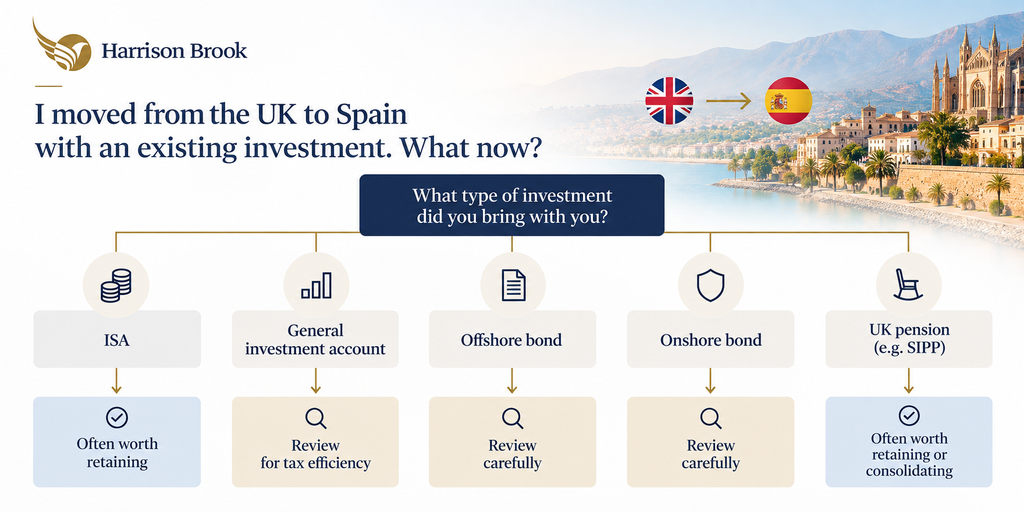
| General investment account | Flexible direct investment in shares, funds, bonds and ETFs | Tax may arise as income is received and gains are realised |
| Existing UK ISA | Often worth retaining where a UK return remains possible | ISA exemption does not determine Spanish taxation |
| UK onshore or offshore investment bond | Existing legacy wealth structure | Spanish treatment can differ significantly from UK treatment |
| UK pension / International SIPP | Retirement capital and potentially multi-currency retirement planning | Pension tax rules and withdrawal timing need Spanish analysis |
There is no universal hierarchy here. Someone intending to spend three years in Madrid before returning to Britain may reach a very different conclusion from somebody who has sold their UK home, bought in Mallorca and expects Spain to remain their permanent base.
That future residence question matters enormously.
1. The Spanish Traspasos Regime: one of Spain’s most useful investment rules
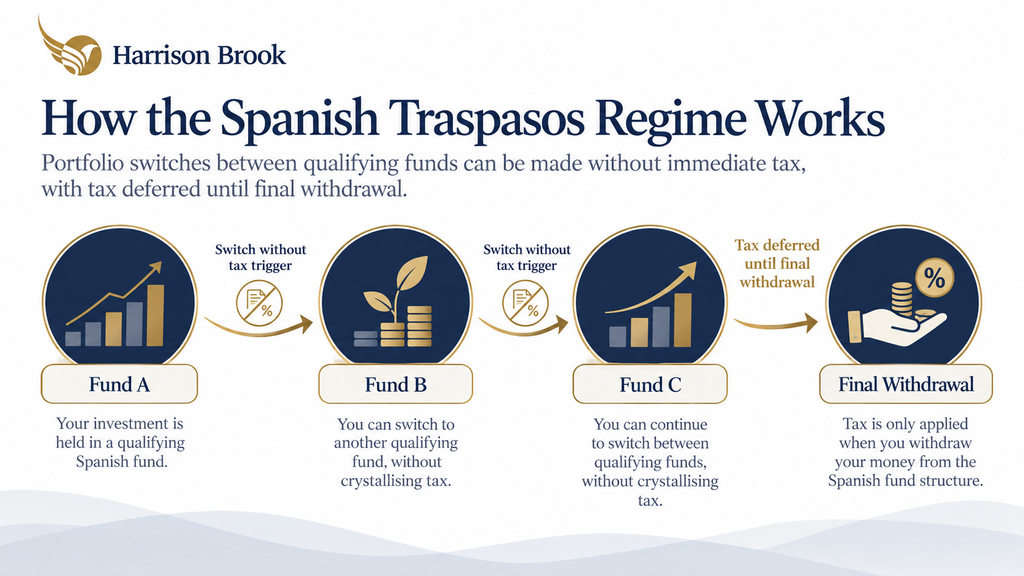
One of the first structures British investors should understand is Spain’s traspasos regime.
Under the qualifying rules, an individual investor can move money from one eligible investment fund into another without crystallising the capital gain at the point of the switch. Instead, the original acquisition value and date carry into the replacement investment. Tax is deferred until the investor ultimately disposes of the investment and takes the money out of the qualifying structure.
This can be extremely useful for long-term portfolio management.
Consider an investor who places €500,000 into a diversified portfolio. Five years later it is worth €650,000, but their circumstances have changed and the portfolio needs to become more defensive.
Inside an ordinary investment account, selling investments with substantial gains can create a Spanish tax liability.
Where qualifying investment funds are switched correctly under traspasos, the portfolio may be restructured without immediately realising those gains for Spanish income-tax purposes.
That allows investment decisions to be driven more by asset allocation, risk and financial planning rather than by the reluctance to trigger a tax bill.
Which investments can qualify?
The regime is broader than simply Spanish-domiciled funds.
Spanish investment funds can qualify, as can qualifying EU UCITS funds registered with Spain’s CNMV and distributed through appropriately registered entities. There are, however, important exclusions and procedural requirements. ETFs, for example, generally do not enjoy the same traspasos treatment.
That makes fund selection only one part of the exercise. The platform, distributor, registration of the fund and actual transfer process also matter.
For a British investor accustomed to selecting ETFs on a UK platform, that can require a change in thinking.
An ETF portfolio may still be perfectly sensible from an investment perspective. It simply does not necessarily provide the same Spanish tax characteristics as a portfolio constructed using qualifying funds.
When does traspasos make most sense?
It tends to become more interesting where an investor has:
- meaningful non-pension capital intended for medium- or long-term investment;
- a portfolio likely to require periodic rebalancing;
- a reasonably long Spanish residence horizon;
- a preference for transparent collective investments rather than an insurance wrapper; and
- sufficient portfolio size for the tax administration and portfolio structure to matter.
For somebody with relatively modest short-term savings that may be required for a house purchase next year, constructing an elaborate traspasos portfolio may add little value.
For a family managing seven figures of internationally invested capital over 15 or 20 years, the ability to alter the portfolio without repeatedly crystallising gains can be considerably more relevant.
2. Spanish-compliant investment bonds
Another structure frequently discussed with British expatriates is the Spanish-compliant investment bond.
The expression “Spanish-compliant bond” is industry shorthand rather than the name of one specific statutory product.
Typically, it refers to an insurance-based investment contract designed so that its operation is compatible with Spanish insurance and tax requirements. EEA insurance companies can operate in Spain through appropriate regulatory arrangements, including the freedom to provide services, and the Spanish insurance regulator maintains registers of authorised insurers.
The tax treatment is particularly important.
Spanish legislation contains specific rules for life assurance contracts where the policyholder bears the investment risk – commonly referred to as unit-linked policies. Where the appropriate statutory conditions are satisfied, the policy can fall within the general taxation rules applying to life assurance rather than having investment growth attributed to the policyholder annually. Where those requirements are not satisfied, Spanish rules can require annual attribution of changes in the underlying value.
That is a significant distinction.
A well-structured policy may therefore allow investments to be changed within the insurance contract without each internal portfolio transaction producing an immediate personal tax event.
But the words “Spanish compliant” on a brochure should never be sufficient due diligence.
The insurer, policy wording, available assets, investor control, underlying portfolio, charges, surrender terms and Spanish tax treatment all warrant examination.
Traspasos fund portfolio or Spanish-compliant bond?
This is often a more useful comparison than asking which investment “performs better”.
Both can provide ways of managing a portfolio without necessarily generating tax every time the underlying investment strategy changes, but their legal structures are very different.
A traspasos portfolio remains an investment-fund arrangement. A compliant bond is an insurance contract.
That affects matters including ownership, access, investment selection, succession planning, reporting, charges and the way withdrawals are taxed.
For some investors, the transparency and relative simplicity of qualifying investment funds will be attractive.
For others – particularly where succession, portfolio administration or particular investment requirements are involved – an insurance-based structure may deserve consideration.
Neither should be adopted purely because it appears to offer “tax efficiency”.
The investment strategy underneath it still has to be good.
3. What happens to your UK ISA when you move to Spain?
This causes more confusion than almost any other investment question.
You are allowed to retain an existing ISA after leaving Britain. It can continue to retain its UK tax advantages, although most non-residents cannot continue contributing new money while they remain non-UK resident.
The problem is that an ISA is a UK tax wrapper.
Spanish tax residence does not turn UK legislation into Spanish legislation.
Spain taxes its residents on worldwide income, subject to treaty provisions. UK-source interest, dividends and many investment gains can therefore fall within the Spanish tax system even where the underlying assets happen to sit inside an ISA in Britain.
So the ISA can remain “tax-free” from HMRC’s perspective while failing to deliver the same result for its owner in Spain.
That does not automatically mean that every British expat should cash in their ISA.
Suppose you are a senior executive spending four years in Barcelona before returning to London. Preserving the ISA wrapper for your eventual UK return may be entirely rational.
Someone who has permanently retired to the Costa del Sol and has no realistic intention of returning to Britain may reach a different conclusion.
Residency plans come before product decisions.
4. General investment accounts: straightforward, but not tax-deferred
There is nothing inherently wrong with holding investments directly through a general investment account.
Indeed, for some investors it is preferable.
A well-designed account can provide broad access to equities, bonds, funds and ETFs, often at relatively low cost and without the legal complexity of an insurance wrapper.
The trade-off is taxation.
Dividends, interest and realised gains generally have to be considered under Spanish tax rules as they arise. Spain’s savings-income scale currently runs progressively from 19% through to 30% at the highest band under the rates introduced from 2025.
That means portfolio turnover has a tax consequence.
For a buy-and-hold investor using very low-cost securities, that may be entirely acceptable. For an actively managed portfolio being rebalanced across several asset classes, the cumulative drag and administration can become more significant.
The cheapest investment structure before tax is not necessarily the most efficient structure after tax.
Equally, an expensive tax wrapper does not become attractive merely because it defers tax.
Both sides of the equation matter.
5. What about an old UK offshore or onshore investment bond?
This is where many long-standing British expats discover that historical planning needs revisiting.
Perhaps you purchased an offshore bond while living in Britain.
Perhaps your adviser placed investments into a UK onshore life assurance bond.
Perhaps the policy was subsequently assigned into trust.
These arrangements may have made sense under UK tax legislation. Offshore bonds, for example, have traditionally been associated with gross roll-up and UK rules allowing cumulative 5% withdrawals without an immediate UK chargeable event.
You should not assume those rules travel with you.
An existing policy does not automatically become legally invalid because you become Spanish resident. However, its Spanish tax treatment must be analysed under Spanish rules.
For investment-linked life assurance, the distinction between policies satisfying Spain’s requirements and policies that do not can be particularly important. Where the statutory conditions are not met, Spain can attribute annual changes in the value of the underlying assets as investment income rather than waiting until benefits are taken.
A UK onshore bond introduces another layer because taxation already taking place within the UK insurer’s life fund does not necessarily produce the same economic result once the policyholder is taxable in Spain.
A legacy offshore bond can create a different set of issues again.
And where a trust owns the policy, the analysis should go beyond the bond itself. UK trust planning should not be assumed to produce the same tax result after the settlor or beneficiaries become Spanish resident.
Before surrendering an old bond
There is a crucial word here: before.
Do not surrender, assign or substantially restructure a valuable legacy policy merely because it appears unsuitable.
An existing gain may already have accumulated inside the contract. Triggering a disposal before understanding both the UK and Spanish consequences can convert a structural problem into an immediate tax problem.
The first exercise should be forensic:
What exactly is the policy? Where is the insurer established? When was it established? What premiums were paid? What is the current surrender value? What investments sit inside it? Who owns it? Has it been assigned? Does it meet the relevant Spanish rules?
Only then does replacement become a planning question.
6. UK pensions and the role of an International SIPP
Investment planning for a British expat in Spain should rarely be considered without reviewing their UK pensions at the same time.
The UK–Spain Double Taxation Convention gives Spain the taxing right over most private pension income received by a Spanish-resident individual. Government-service pensions are subject to different rules.
This can make retirement planning materially different from retirement in Britain.
In particular, UK terminology such as a “25% tax-free lump sum” should be treated with caution once the pension holder is Spanish tax resident. The fact that a withdrawal may receive favourable treatment under UK pension legislation does not by itself establish its Spanish treatment.
Withdrawal strategy therefore deserves planning before benefits are crystallised.
Should a British expat in Spain use an International SIPP?
Potentially – but not simply because it has the word “international” in the name.
An International SIPP remains fundamentally a UK pension arrangement designed to accommodate people living outside Britain. Depending on the provider, it may offer multi-currency investment, international platforms, wider investment access and administration designed for non-UK residents. Harrison Brook describes its International SIPP offering as retaining a UK-regulated pension framework while providing functionality intended for expatriate clients.
For someone with several old defined-contribution pensions, consolidation can sometimes improve administration, investment consistency and currency management.
For somebody with a good existing pension at low cost, transferring merely for the sake of consolidation can be unnecessary.
Defined-benefit pensions require a quite different analysis again and should not be treated as interchangeable with ordinary investment pots. Harrison Brook is not regulated to provide Defined Benefit pension advice.
The objective should be to make the pension fit the client’s retirement plan in Spain rather than simply moving it onto a platform carrying an expatriate label.
7. Do not forget Spanish reporting and wealth taxation
Portfolio construction is only part of living in Spain with international wealth.
Spanish residents can also have reporting obligations for assets held outside Spain. The Modelo 720 regime covers categories including overseas accounts, securities, rights, insurance policies and property, subject to the applicable thresholds and filing rules. The Spanish Tax Agency currently states an initial €50,000 threshold for each relevant asset category and further reporting where the relevant value subsequently increases by more than €20,000 compared with the last reported position.
For wealthier families, Spanish Wealth Tax and the national Temporary Solidarity Tax on Large Fortunes can also form part of the analysis. The latter continues to operate in 2026, with the Spanish Tax Agency describing it as applying to net wealth exceeding €3 million, although actual liability interacts with exemptions, regional Wealth Tax rules and the taxpayer’s circumstances.
This is one reason investment planning cannot be separated neatly from tax residence and location.
What does good investment planning in Spain actually look like?
A British couple retiring to Marbella with £2 million of investments, two SIPPs, an ISA portfolio and an old Isle of Man bond need more than a model portfolio.
So does an entrepreneur who has sold a UK company and moved with their family to Madrid.
The process should begin with the family’s overall position:
- Where are they tax resident today?
- Where are they likely to be resident in five years?
- Which assets need to provide income?
- Which capital might eventually pass to children?
- Which currency will fund their lifestyle?
- What existing gains would be triggered by restructuring?
- Which investments can be retained?
- Which structures no longer perform the role for which they were originally established?
Only after answering those questions does it make sense to decide whether capital belongs within traspasos-eligible funds, a Spanish-compliant bond, a straightforward investment account, an existing UK wrapper or a pension.
That planning discipline is particularly important for internationally mobile clients because residence, taxation, regulation and portfolio construction are related but separate questions.
Financial planning for British expats across Spain
The issues discussed in this guide arise throughout Spain: from British retirees in Mallorca, Marbella, Málaga, the Costa del Sol, Alicante and the Costa Blanca, to internationally mobile executives and families in Madrid, Barcelona and Valencia, as well as expatriates living in the Canary Islands.
Geography may change the lifestyle. The underlying planning questions remain remarkably consistent.
A British financial planner working with clients in Spain needs to understand the UK structures the client arrived with while also recognising where Spanish taxation and European regulation change the analysis.
That combination is increasingly important as clients carry pensions, ISAs, trusts, investment companies and internationally held portfolios from one country to another.
A sensible 2026–2027 checklist
Before changing an investment portfolio after moving to Spain, establish:
- Your actual tax residence. Visa residence and tax residence are not the same thing.
- Your likely future residence. A temporary four-year assignment should not necessarily be planned like permanent retirement.
- What you already own. Obtain original costs, acquisition dates, policy documents and current valuations.
- What Spain taxes. Do not assume an ISA, pension lump sum or investment bond receives the same treatment it had in Britain.
- Whether traspasos can be used. For taxable investment capital, qualifying funds can provide considerable flexibility.
- Whether an insurance wrapper genuinely qualifies. “Spanish compliant” should be demonstrated, not merely advertised.
- Your total cost. Tax deferral can be valuable, but excessive insurance, platform, investment and advisory costs can consume that benefit.
- Your pension withdrawal strategy. The timing and form of withdrawals can matter considerably once you are Spanish resident.
- Your reporting position. Overseas assets can create Spanish disclosure obligations even when no immediate tax is payable.
- Your family and succession position. An investment that works during your lifetime may create an entirely different issue on death or succession.
Final thoughts
Spain offers British expatriates several credible ways to invest efficiently.
The traspasos regime can be particularly powerful for long-term fund investors because it allows qualifying portfolios to evolve without repeatedly crystallising gains. Spanish-compliant life assurance can provide another form of tax deferral where the contract genuinely satisfies the appropriate requirements. General investment accounts remain useful where flexibility and low structural cost are more important than tax deferral.
Meanwhile, legacy British structures deserve to be reviewed rather than automatically discarded.
An ISA can remain valuable if a return to Britain is plausible, even though its UK exemption does not dictate its Spanish tax treatment. An old offshore or onshore bond may require restructuring, but surrendering it without first understanding the accumulated gain can be expensive. UK pensions can remain perfectly workable for a Spanish resident, while an International SIPP may improve administration, investment choice or currency flexibility for some clients without being necessary for everyone.
For 2026 and 2027, the most robust approach is therefore not to search for a single “Spanish investment product”.
It is to build the investment architecture around where you live, how long you expect to remain there, what assets you already own and how you intend to use your wealth over the coming decades.
For British expatriates with substantial UK pensions, investments, trusts or internationally held assets, that distinction can be far more important than choosing the next fund.
FAQs – How to Invest as a British Expat in Spain?
What is the most tax-efficient investment for a British expat in Spain?
There is no single structure that suits every Spanish resident. Qualifying investment funds using the traspasos regime and appropriately constructed Spanish-compliant life assurance policies can both provide tax-deferral advantages, but their suitability depends on portfolio size, costs, investment requirements, access needs and future residence.
Can I keep my ISA if I move to Spain?
Yes. A UK ISA can generally remain open and retain its UK tax treatment, although most non-UK residents cannot make new subscriptions. A Spanish tax resident should not assume Spain will recognise the ISA’s UK tax exemption.
Are ETFs tax-efficient in Spain?
ETFs can be low-cost and useful investments, but they do not generally qualify for the traspasos tax-deferral regime available to qualifying investment funds.
Does my UK offshore bond still work in Spain?
The contract may remain legally valid, but its Spanish tax treatment can differ substantially from its UK treatment. The policy terms, insurer, underlying assets and Spanish unit-linked rules should be reviewed before withdrawals, assignments or surrender.
Should I transfer my UK pension into an International SIPP after moving to Spain?
Not automatically. An International SIPP can make sense where existing UK pensions are difficult to administer overseas, where consolidation is beneficial, or where multi-currency and international investment functionality are important. A good existing scheme may be better left untouched. The Spanish taxation of future withdrawals should form part of the analysis before any transfer is made.